
Vinoba Bhave
Bhave, Vinoba
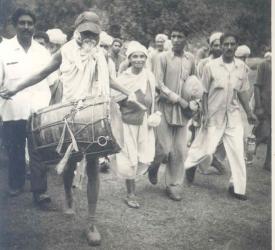
Description
Vinoba Bhave (1895-1982) was born in Gagode Budruk, India. From a young age he was a voracious reader with an aptitude for languages, and interest in Hindu philosophy as well as social reform. At the age of twenty he decided to embrace a spiritual path and forego higher education as well as the married life of a householder. In 1916, Bhave arrived at Sabarmati Ashram after reading about Gandhi in the press and briefly exchanging letters. Gandhi invited Bhave to join the community. Bhave initially helped with the education program, and increasingly took on more responsibilities. Gandhi approved of Bhave’s commitment to nonviolence and celibacy, and appreciated his intellectual contributions to the community, enjoying especially their ongoing discussion of the Bhagavad Gita (Bhave eventually published his own translation and commentary on this Hindu text). When Gandhi decided to establish a satellite community of Sabarmati Ashram near Wardha, Maharashtra (India), in 1921, he sent Bhave to manage it.
Bhave worked alongside Gandhi during various anticolonial campaigns, and was imprisoned for his nonviolent civil resistance on multiple occasions. During the Quit India campaign of 1942 Bhave was sent to Yeravda Central Prison, where he served a five-year sentence. Bhave recorded in his memoir that he remained ever ready to fulfill his pledge to fast unto death if Gandhi sent him the order, writing “I would have done it not from knowledge (like Bapu/Gandhi) but from faith. I have no doubt at all that an individual can make such a sacrifice, with the fullest reverence and love, in obedience to an order accepted in faith.”
In the months and years immediately following Gandhi’s assassination in 1948, Bhave managed the day-to-day affairs of Sevagram Ashram, traveling between the Sevagram community and the nearby community that he had founded in Paunar, Maharashtra. In the 1950s, Bhave walked throughout central India on a Bhoodan Yajna, or Land Gift Pilgrimage, persuading landowners to give small plots of farmable land to landless villagers so that they could live rent-free and engage in subsistence farming. In 1959, Bhave gave the Paunar ashram to a small group of women who had joined him in walking on his Land Gift movement, and who wanted to form their own spiritual community (which they called the Brahma Vidya Mandir); Bhave in turn went on to establish several additional ashrams before his death in 1982.