
Sushila Nayar
Nayar, Sushila
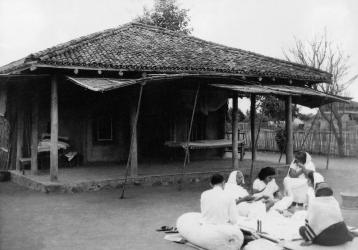
Description
Sushila Nayar (1914-2001) was born in Kunjah, India (now a part of Pakistan). She became acquainted with Gandhi through her elder brother, Pyarelal Nayar, who resided at both Sabarmati Ashram and Sevagram Ashram. When Sushila was a college student studying medicine at Lady Hardinge Medical College in Delhi, India, she began to visit Gandhi’s communities and spent time in residence there during her college breaks. In 1939, after completing her MD degree, Sushila joined the Sevagram Ashram community.
At Sevagram Ashram, Sushila was trained in the ideals of universal wellbeing (sarvodaya), nonviolent civil resistance (satyagraha), and selfless service (seva). Gandhi appreciated her medical service to the local villagers and to the volunteer residents who joined the growing community, as outbreaks of malaria and cholera were then common in the villages of central India. While living at Sevagram Ashram, Sushila established a medical clinic there, which was later expanded and moved to the nearby town of Wardha, and then eventually expanded further to become the Kasturba Hospital (named in honor of the late Kasturba Gandhi), and is now the Mahatma Gandhi Institute of Medical Sciences. Sushila served as a personal physician to Gandhi, helping him with his own recovery after extended fasts and with other ailments. In addition to rendering her medical expertise as service to the community and surrounding villages, Sushila also participated in the anticolonial campaigns that were initiated at Sevagram Ashram. She was arrested for her participation in the Quit India campaign, and was imprisoned in the Aga Khan Palace prison from 1942-1944. Finally, Sushila was one of Gandhi’s partners in his controversial experiments in celibate sexuality.
After Gandhi’s assassination in 1948, Sushila traveled to the United States where she undertook further study at Johns Hopkins School of Public Health. After returning to India, Sushila continued to serve the public in both medical and political capacities. She twice served as the national Health Minister of India, and also established foundations that were dedicated to tackling the diseases of leprosy and tuberculosis. With her brother, Pyarelal Nayar, she also authored numerous books about Gandhi.