
Santok Gandhi
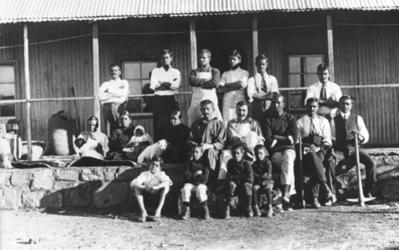
Description
Santok Gandhi was born in India, and married at a young age to Maganlal Gandhi, who was Gandhi’s cousin once removed, whom Gandhi often referred to as his nephew. After her husband Maganlal followed Gandhi to South Africa in 1903 for employment opportunities, Santok followed her husband to South Africa in 1904. Later in 1904 Santok and Maganlal moved to Phoenix Settlement, becoming some of the earliest members of Gandhi’s first intentional community. Santok took part in the daily life at Phoenix Settlement, learning to farm and to help operate the printing press. Her children were born at Phoenix Settlement.
In South Africa, Santok and her husband became involved in helping to carry out Gandhi’s nonviolent civil disobedience campaigns. Santok and her children spent some time at Tolstoy Farm, Gandhi’s second intentional community in South Africa, when Maganlal was in prison in Johannesburg for civil disobedience. Santok participated in the Great March for Indians’ civil rights in South Africa in 1913, and was herself sentenced to three months in prison with hard labor.
When Gandhi departed South Africa in 1914, Santok, Maganlal, and their children elected to return to India, where they helped to build Sabarmati Ashram, Gandhi’s third intentional community. Santok and Maganlal took on increasing responsibilities at Sabarmati Ashram, with Maganlal serving as the de facto figure in charge whenever Gandhi was away. Given their orthodox Hindu background, Santok and Maganlal struggled at times with some of the communal values, most notably the effort to remove untouchability and to cohabit with a Dalit family. Santok elected to leave Sabarmati Ashram in 1928, after her husband passed away.