
Parchure Shastri
Shastri, Parchure
Timeline
| Death: | 1945 |
| India |
Description
Parchure Shastri (?-1945) was born into the Brahmin caste and well-educated in the Sanskrit scripture of classical Hinduism. He was also a poet and an activist in India’s independence struggle. Gandhi and Parchure first met in the summer of 1932, while both men were imprisoned for civil disobedience during the Salt Satyagraha anticolonial protest. Gandhi learned that Shastri was being held in the same jail as he, but in an isolated cell because he had contacted leprosy (Hansen’s disease). Gandhi asked for permission to meet Shastri while they were both imprisoned, but was denied, so they began to correspond regularly with one another.
By 1939, Shastri’s illness had advanced significantly. At that time, leprosy was viewed not only as a contagious medical disease, but also as a ritually polluting condition. Although born into a high caste, Shastri had been deemed outcaste by society – even many medical professionals would refuse to treat leper patients. When Gandhi learned that Shastri was suffering greatly and his body was wasting away, he not only invited Shastri to live at Sevagram Ashram, but also pledged to personally care for him. Gandhi would daily attend to Shastri by washing his wounds, applying new medicine and bandages, massaging his legs, and feeding him a meal. Gandhi encouraged his other coresidents to similarly care for those who had been outcaste by society, whether for medical reasons or for their caste status, preaching to them the concept of seva, selfless service of all for the greater good.
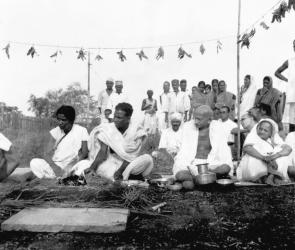
“Parchure Kuti,” or Parchure’s Hut, was built not far from Gandhi’s own hut at Sevagram Ashram, and is still extant today. Shastri lived there for several years. As his health permitted, Gandhi occasionally called on Shastri to perform ceremonial rituals – including officiating at several intercaste and interfaith weddings that were held at Sevagram Ashram as part of the ongoing effort to abolish caste prejudice and untouchability. In 1942, when Gandhi launched the Quit India campaign from Sevagram Ashram and anticipated that he would again face imprisonment for anticolonial activity, he ensured that Parchure Shastri was moved to a home for leprosy patients in nearby Wardha (Dattapur), Maharashtra. Shastri remained there until his death in 1945.