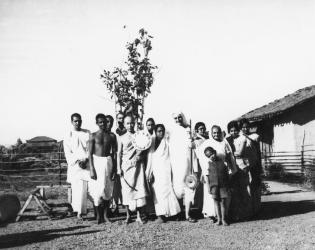
Mirabehn’s birth name was Madeleine Slade (1892-1982). She was originally from England, and was the daughter of Sir Edmond Slade, a Royal Navy officer who served as Director of the Naval Intelligence. She first learned of Gandhi from her friend Romain Rolland, the French author who wrote a biography of Gandhi in 1924. Slade read Rolland’s biography and felt called to Gandhi, writing in her memoir The Spirit’s Pilgrimage (published in 1960), “The call was absolute, and that was all that mattered.” Slade wrote to Gandhi, who invited her to come and join him. In 1925, Slade gave away her possessions, said goodbye to her family, and arrived in India.
Gandhi embraced Madeleine Slade as both a coresident and a spiritual co-seeker. Madeleine Slade became known as Mirabehn, the name that Gandhi affectionately bestowed upon her. Mirabehn first lived at Sabarmati Ashram with Gandhi, and then at Sevagram Ashram. At Sabarmati Ashram, Mirabehn began to study Hindi and Gujarati languages, and joined the life of the community by taking turns on sanitation duty, learning to cook Indian meals, spinning cotton, and joining group prayer sessions. During these years at Sabarmati Ashram, Mirabehn grew increasingly active in the Indian freedom struggle. When the Salt Satyagraha began in 1930, Mirabehn took part in the civil disobedience movement. She accompanied Gandhi to the second Round Table Conference in London (1931); was imprisoned for civil disobedience (1932-33); and wrote news essays and traveled to England and the United States to meet dignitaries and make the case for India’s freedom (1934).
Mirabehn was instrumental to the founding of Sevagram Ashram, Gandhi’s final intentional community. It was Mirabehn who initially went to live in Segaon village, which was later renamed Sevagram Ashram, seeking (at Gandhi’s suggestion) to teach the villagers methods of sanitation as well as spinning. When Mirabehn fell ill and could not continue this constructive work, Gandhi came to take her place. Eventually, a new community arose around Gandhi and the villagers as more volunteers came to join Gandhi there. Gandhi particularly admired Mirabehn’s skill in building simple huts out of local materials. This skill can still be observed at Bapu Kuti (Gandhi’s Cottage), which has been preserved at Sevagram Ashram. Mirabehn remained active in the freedom struggle while living at Sevagram Ashram. Gandhi sent her to organize nonviolent Quit India protests in eastern India in 1942, and she was eventually arrested and imprisoned. Mirabehn remained in India for a dozen years after the nation attained independence, where she continued to engage in constructive work in villages until 1959. She then moved to Austria in 1960 for her retirement, where she continued to live a simple life.