
Maganlal Gandhi
Gandhi, Maganlal
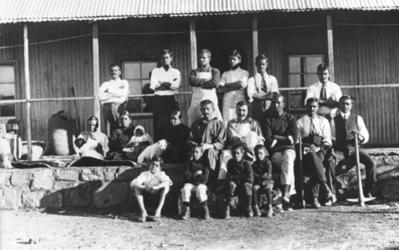
Description
Maganlal Gandhi (1883-1928) was born in India. He was Gandhi’s cousin once removed (the son of Gandhi’s older cousin Kushalbhai Gandhi), although Gandhi often referred to Maganlal his nephew. As a young man Maganlal went to South Africa in 1903 for employment opportunities, following in Gandhi’s footsteps, and initially worked in a merchant’s shop in Tongaat township (near Durban) and then at a branch store in Stanger township. In 1904, when Gandhi was establishing his first community, he invited Maganlal to join Phoenix Settlement. Maganlal was among the first residents to join the Phoenix community, and brought his wife Santok from India to join him in residence there. Their children were born at Phoenix Settlement.
Maganlal embraced life at Phoenix Settlement. He was a hard worker, and quickly began to contribute to the printing press work in order to publish the Indian Opinion weekly newspaper, as well as farming work. Maganlal also embraced Gandhi’s experiments, and while living at Phoenix Settlement he made vows to practice nonviolence and celibacy. As the residents of Phoenix Settlement and Tolstoy Farm grew more involved in anticolonial political campaigns, Gandhi increasingly looked to Maganlal to keep Phoenix Settlement, and Indian Opinion newspaper, operational while he and other residents were imprisoned for civil disobedience.
When Gandhi departed South Africa in 1914, Maganlal, Santok, and their children elected to return to India, where they helped to build Sabarmati Ashram, Gandhi’s third intentional community. Maganlal and Santok took on increasing responsibilities at Sabarmati Ashram, with Maganlal serving as the de facto figure in charge whenever Gandhi was away. Given their orthodox Hindu background, Santok and Maganlal struggled at times with some of the communal values, most notably the effort to remove untouchability and to cohabit with a Dalit family. When Maganlal passed away suddenly from pneumonia in 1928, Gandhi mourned his passing deeply, describing Maganlal in his obituary as the “watchdog” of Sabarmati Ashram in its material, moral, and spiritual aspects, and as dearer to him than his own sons.