
Kasturba Gandhi
Gandhi, Kasturba
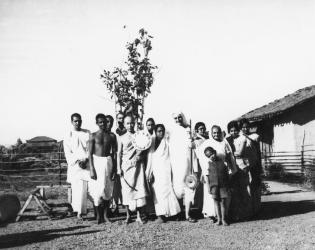
Description
Kasturba Gandhi (1869-1944) was born in Porbandar, India. She met Gandhi when they were both young teenagers, in a marriage arranged by their parents. When Gandhi accepted a position in South Africa in 1893, Kasturba initially stayed in India. However, after Gandhi decided that he would stay in South Africa longer than his initial twelve-month contract, Kasturba moved to there to join him. Her first two sons, Harilal and Manilal, were born in India, while her youngest two sons, Ramdas and Devdas, were born in South Africa. In the summer of 1906, Kasturba and her sons moved to join Gandhi and the newspaper press workers at Gandhi’s first intentional community, Phoenix Settlement.
The transition to rural farm life and to a new set of communal rules at Phoenix Settlement was not easy for Kasturba, and she did not always agree with all of the communal rules that Gandhi sought to implement. For instance, Kasturba voiced her skepticism on multiple occasions about the alternative education her sons were receiving in place of attending more accredited educational institutions. Gandhi wrote about some of the disagreements they had in his autobiography as well as in personal correspondence, and occasionally discussed them in his public talks. We have less insight into Kasturba’s mindset, however, as she did not write about her life experiences.
Kasturba was in residence with Gandhi at all of his intentional communities. Although Kasturba and Gandhi remained married until her death in 1944, they practiced celibacy from 1906 forward. Kasturba grew politically active in South Africa, and she elected to participate in the Great March there in pursuit of greater civil rights for Indians. After Kasturba and Gandhi returned to India in 1915, Kasturba continued to participate in nonviolent anticolonial movements, including taking a leading role in the Dharasana Salt satyagraha of 1930 as well as the Quit India satyagraha of 1942. Kasturba received multiple prison sentences for participating in nonviolent civil disobedience movements, beginning with her first imprisonment in South Africa, and ending with her final prison sentence in India during the Quit India campaign. Kasturba died in the Aga Khan Palace prison in 1944.