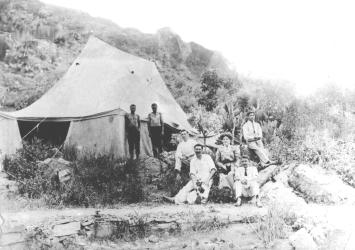
Hermann Kallenbach (1871-1945) was born into a large Lithuanian Jewish family. He studied at the Royal School for Architects in Stuttgart, graduating in 1896 with qualifications as a carpenter, mason, and architect. After graduating and completing a year of military service, Kallenbach moved to Johannesburg, South Africa, where he began practicing as an architect, eventually becoming a senior partner in the firm Kallenbach & Reynolds. Kallenbach first met Gandhi in Johannesburg through a mutual friend. In the early years of their acquaintance they met over meals at vegetarian restaurants, and Gandhi persuaded Kallenbach to join him in implementing daily habits of self-discipline, including giving up meat, alcohol, and tobacco, and practicing greater fiscal discipline. When Gandhi was released from prison in 1908, he left his wife and four sons at Phoenix Settlement for the time being, and began to live with Kallenbach in his home in Johannesburg to remain closer to the court and prison as the struggle for Indian civil rights in South Africa continued.
In May of 1910, Kallenbach purchased 1,100 acres of farmland in a rural setting twenty-two miles southwest of Johannesburg, to co-found (along with Gandhi) Tolstoy Farm. A dilapidated farmhouse came with the land, and though it was in dire need of repair, Gandhi and Kallenbach agreed that it was suitable for their immediate habitation while they made improvements to the property in preparation for the arrival of the civil resisters and their families. Gandhi and Kallenbach named the community Tolstoy Farm in honor of Count Leo Tolstoy, for they had each been impacted by his writing. At Tolstoy Farm the residents built upon many of the values and practices from Phoenix Settlement, but they also undertook additional experiments in cohousing, celibacy, farming, dietary restriction, economic self-sufficiency, alternative medicine, home schooling, and multifaith community building as their collective understanding of universal wellbeing continued to evolve.
When Gandhi was preparing to leave South Africa and return to India in 1914, the residents of Tolstoy Farm and Phoenix Settlement had to decide if they wanted to remain in South Africa or move to India with Gandhi. Kallenbach elected to go to India. However, the outbreak of World War I altered the course of Kallenbach’s life. Kallenbach had lived in South Africa for the past eighteen years, but was technically a German citizen. As such, England declared him an “enemy alien,” and he was sent to a detention camp on the British Isle of Man from 1915-1917. After Kallenbach was released in a prisoner exchange in 1917, he decided not to move to India – indeed, he did not travel to India until many years later, visiting Gandhi at Sevagram Ashram in 1937 and 1939 – but instead returned to South Africa. There, he ultimately sold the Tolstoy Farm land and made Johannesburg his home base for professional reasons, resuming his work as an architect and growing increasingly active as a member of the Jewish community there and in the Zionist cause.