
Heresies
Vol. 5, No. 4, 1985
-
-
Read the Issue
Explore Issue #20 in PDF format with full-text search or as individual entity-tagged TEI documents (coming soon).
The Issue 20 Collective
Editorial Collective: Pennelope Goodfriend, Kathy Grove, Shirley Irons, Ann Litke, Robin Michals, Kristin Reedm Ellen Rumm, Linda Peer, Susan Woolhandler
Design: Robin Michals, Kristin Reed
Typesetting: Kathie Brown
Production: Robin Michals, Kristin Reed, Tasha Depp, Keith Christensen, Morgan Gwenwald, Mary O'Shaughnessy
Staff: Pennelope Goodfriend, Kay Kenny
Advisors: Vivian E. Browne, Ada Ciniglio, Elaine Lustig Cohen, Eleanor Munro, Linda Nochlin, Barbara Quinn, Jane Rubin, Ann Sperry, Rose Weil
From the Issue 20 Collective
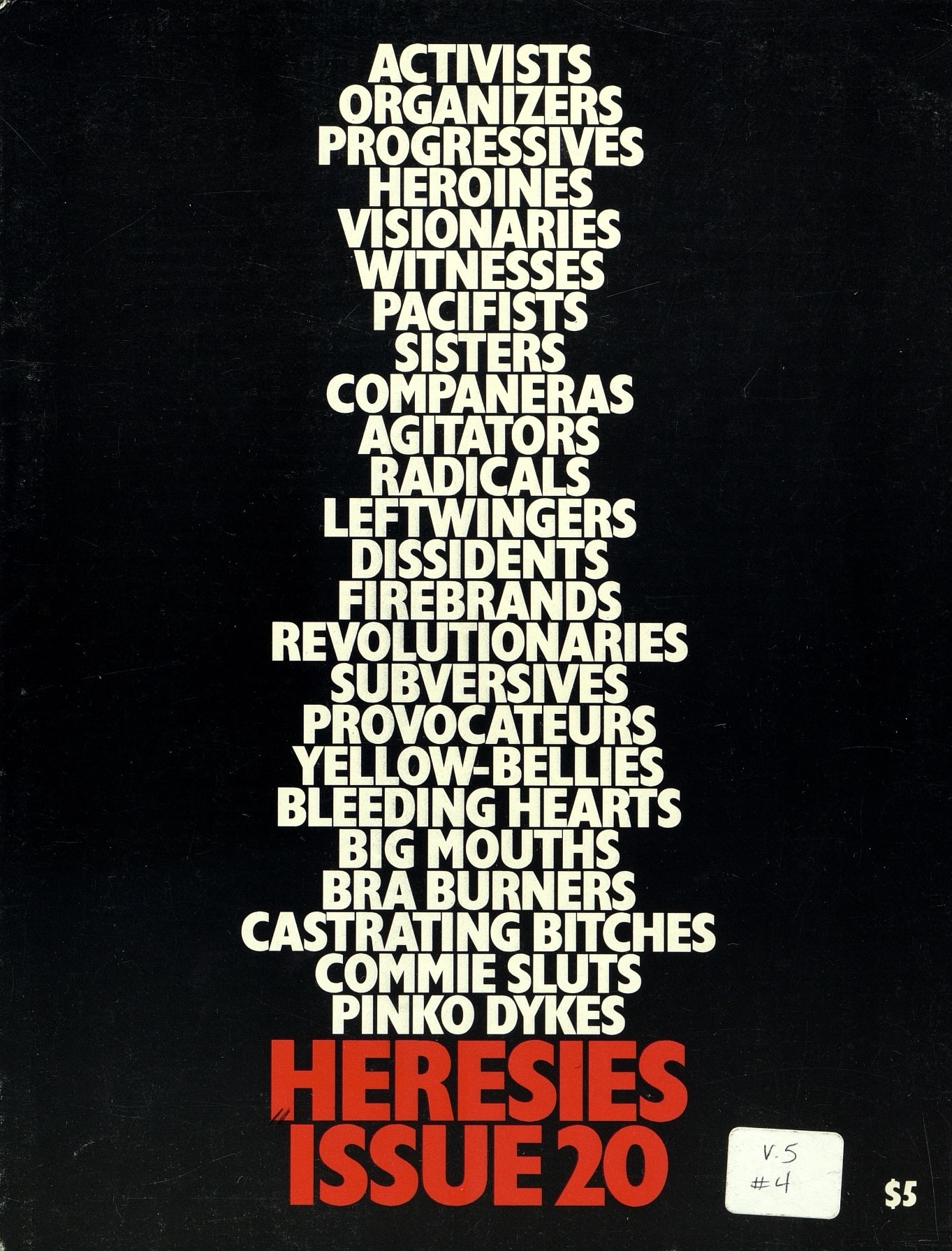
The story of HERESIES 20...
parallels that of its subject, women's activism, as the thread of its original idea kept encircling more and larger issues, slowly turning into a tangled knot. And we members of the collective, like all activists, swung from enthusiasm to perseverance to frustration and back.
The original premise sounded simple—the issue was to be the story ot women working in the peace movement. The difficulties arose as soon as we tried to define the term 'peace movement.' The members of the collective firmly believe that one of the overwhelming contributions of feminism is its insistence on seeing the connections—that the world view which determines the United States' involvement in Central America also defines an attitude toward race and gender. Feminism wants it acknowledged that our treatment of the homeless has a great deal to do with our abuse of the earth and our attitude toward class.
So, still with great enthusiasm, we solicited articles on everything that connected, in the broadest sense, with the peace movement. We then ran headlong into the problem encountered by most organizers of demonstrations, and many painters and writers and, indeed, all responsible people. If you try to tackle everything, do you end up with nothing? But if you focus and make things clear and straightforward, have you left out the connections which were your raison d'etre in the first place?
That knot was loosened by following the line that most strongly affected us. In reading the work submitted, we found that we were impressed by the lives of women who became activists, by the choices they made and their reasons for doing so. At the risk of sounding sentimental, we were touched that, in a time of emphasis on career and investment opportunities, these women had made a decision that a political and social commitment were more important.
We wanted to know more about these people and the work they do. In order to reach as many as possible, including those without the time to write an entire article, we developed a questionnaire asking individuals how they became activists and how that decision affected their personal, moral and political lives.
The writing of those questions required hours of discussions as we tried to put language to beliefs and experiences that had never before needed such explicit definition. At the beginning we found ourselves concentrating on the negative aspects of political involvement, forming questions that reflected our own frustrations with commitments, time, guilt and belief. We found ourselves inadvertently saying that we knew the good parts, what we needed was help in getting through the bad. We changed that emphasis, realizing the positive aspects need reinforcing, especially in the current political climate.
Political differences surfaced when words and phrases at times seemed to assume a specific ideology. We tried hard to be aware of how the stating of a question can manipulate the answer, and to develop ways of asking things those were open to varied social or political beliefs. Yet we also wanted enough structure so that a respondent had a base on which to build her replies, a starting point for her thinking.
It seemed that in every phrase of this project the same conundrum arose—how to include the broadest range of issues and not lose the primary focus. Some of the major concerns of activists today were lost. On the other hand, we gathered unexpected resources—a woman from Northern Ireland telling a personal story of horrible violence, a report from the women who left their homes to sef up a new kind of community at Greenham Common, an interview with a woman in jail because ot her beliefs.
In the end, the tangled skein remains just that—we followed one line through but no great unraveling ot the knot took place. Here are the voices of many women, saying who they are and what issues deeply concern them and what they are doing to change their lives and the lives of others. This magazine is a celebration of these women and the work they have done.