
Mithila is a large region in North Bihar with an ancient high culture which is represented in the Sanskrit written tradition of the Brahman caste. The "painting women of Mithila" who belong to this elite sociocultural stratum are a numerical minority. They have more leisure time to practice their art skills than do women of lower castes.
What is specific to the art of these Maithil women? To answer this question it is necessary to understand the traditional hierarchy of arts and artisans. As in our own culture, manual labor and handmade art such as sculpture or painting have, in spite of highly developed techniques and theories, been considered less prestigious professions than mental labor and intellectual art like poetry. In a male-dominated hierarchical society like India's, the latter sphere is traditionally occupied, with few exceptions, by men of high rank. Tasks requiring skilled hands are relegated to low-caste occupational specialists.
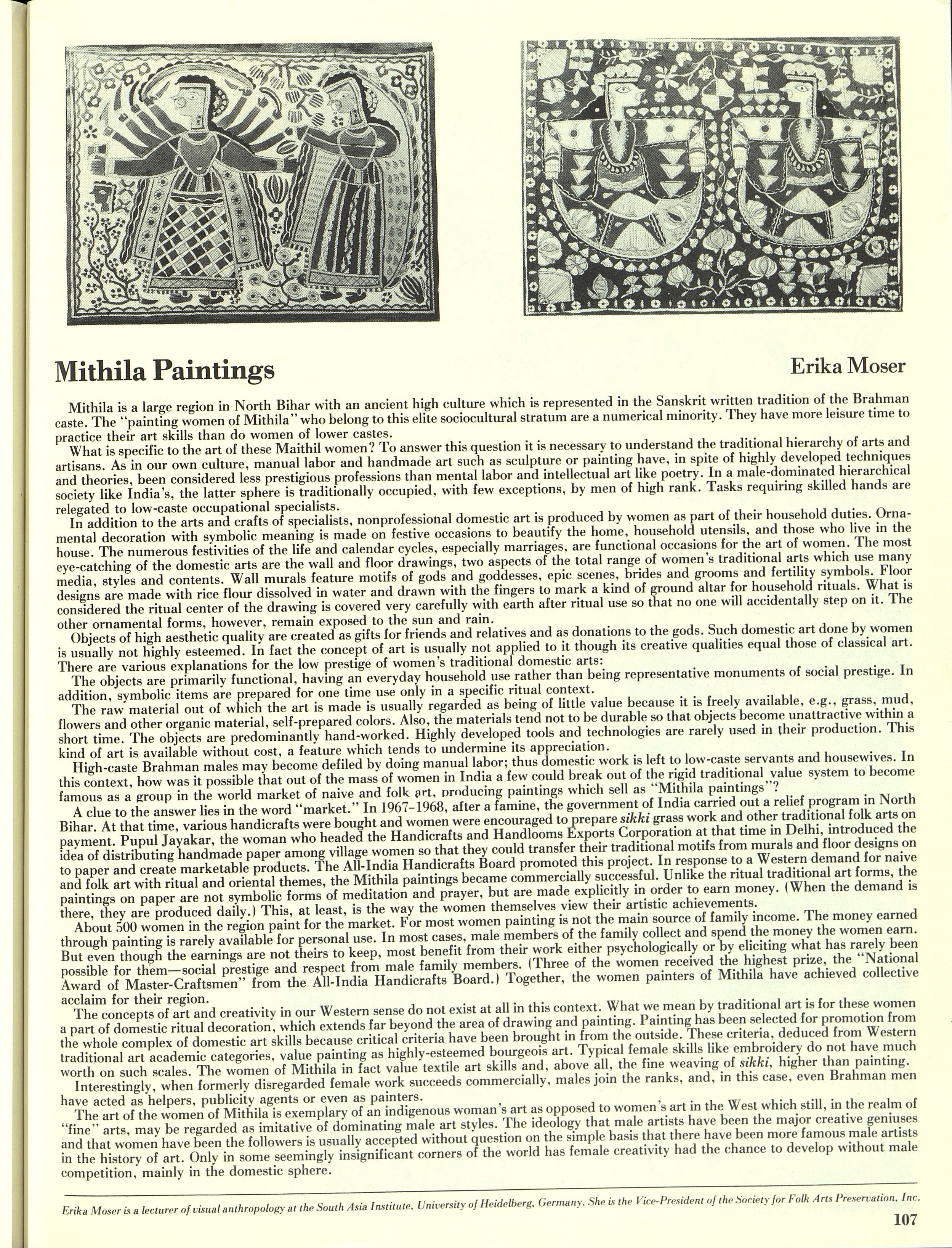
In addition to the arts and crafts of specialists, nonprofessional domestic art is produced by women as part of their household duties. Ornamental decoration with symbolic meaning is made on festive occasions to beautify the home, household utensils, and those who live in the house. The numerous festivities of the life and calendar cycles, especially marriages, are functional occasions for the art of women. The most eye-catching of the domestic arts are the wall and floor drawings, two aspects of the total range of women's traditional arts which use many media, styles and contents. Wall murals feature motifs of gods and goddesses, epic scenes, brides and grooms, and fertility symbols. Floor designs are made with rice flour dissolved in water and drawn with the fingers to mark a kind of ground altar for household rituals. What is considered the ritual center of the drawing is covered very carefully with earth after ritual use so that no one will accidentally step on it. The other ornamental forms, however, remain exposed to the sun and rain.
Objects of high aesthetic quality are created as gifts for friends and relatives and as donations to the gods. Such domestic art done by women is usually not highly esteemed. In fact the concept of art is usually not applied to it, though its creative qualities equal those of classical art. There are various explanations for the low prestige of women's traditional domestic arts:
The objects are primarily functional, having an everyday household use rather than being representative monuments of social prestige. In addition, symbolic items are prepared for one time use only in a specific ritual context.
The raw material out of which the art is made is usually regarded as being of little value because it is freely available, e.g., grass, mud, flowers and other organic material, self-prepared colors. Also, the materials tend not to be durable so that objects become unattractive within a short time. The objects are predominantly hand-worked. Highly developed tools and technologies are rarely used in their production. This kind of art is available without cost, a feature which tends to undermine its appreciation
High-caste Brahman males may become defiled by doing manual labor; thus domestic work is left to low-caste servants and housewives. In this context, how was it possible that out of the mass of women in India a few could break out of the rigid traditional value system to become famous as a group in the world market of naive and folk art, producing paintings which sell as "Mithila paintings"?
A clue to the answer lies in the word "market." In 1967-1968, after a famine, the government of India carried out a relief program in North Bihar. At that time, various handicrafts were bought and women were encouraged to prepare sikki grass work and other traditional folk arts on payment. Pupul Jayakar, the woman who headed the Handicrafts and Handlooms Exports Corporation at that time in Delhi, introduced the idea of distributing handmade paper among village women so that they could transfer their traditional motifs from murals and floor designs or to paper and create marketable products. The All-India Handicrafts Board promoted this project. In response to a Western demand for naive and folk art with ritual and oriental themes, the Mithila paintings became commercially successful. Unlike the ritual traditional art forms, the paintings on paper are not symbolic forms of meditation and prayer, but are made explicitly in order to earn money. (When the demand is there, they are produced daily.) This, at least, is the way the women themselves view their artistic achievements.
About 500 women in the region paint for the market. For most women painting is not the main source of family income. The money earned through painting is rarely available for personal use. In most cases, male members of the family collect and spend the money the women earn. But even though the earnings are not theirs to keep, most benefit from their work either psychologically or by eliciting what has rarely been possible for them—social prestige and respect from male family members. (Three of the women received the highest prize, the "National Award of Master-Craftsmen" from the All-India Handicrafts Board.) Together, the women painters of Mithila have achieved collective acclaim for their region.
The concepts of art and creativity in our Western sense do not exist at all in this context. What we mean by traditional art is for these women a part of domestic ritual decoration, which extends far beyond the area of drawing and painting. Painting has been selected for promotion from the whole complex of domestic art skills because critical criteria have been brought in from the outside. These criteria, deduced from Western traditional art academic categories, value painting as highly-esteemed bourgeois art. Typical female skills like embroidery do not have much worth on such scales. The women of Mithila in fact value textile art skills and, above all, the fine weaving of sikki, higher than painting. Interestingly, when formerly disregarded female work succeeds commercially, males join the ranks, and, in this case, even Brahman men have acted as helpers, publicity agents or even as painters.
The art of the women of Mithila is exemplary of an indigenous woman's art as opposed to women's art in the West which still, in the realm of "fine" arts, may be regarded as imitative of dominating male art styles. The ideology that male artists have been the major creative geniuses and that women have been the followers is usually accepted without question on the simple basis that there have been more famous male artists in the history of art. Only in some seemingly insignificant corners of the world has female creativity had the chance to develop without male competition, mainly in the domestic sphere.
Erika Moser is a lecturer of visual anthropology at the South Asia Institute, University of Heidelberg, Germany. She is the Vice-President of the Society for Folk Arts Preservation, Inc.
Mithila is a large region in North Bihar with an ancient high culture which is represented in the Sanskrit written tradition of the Brahman caste. The "painting women of Mithila" who belong to this elite sociocultural stratum are a numerical minority. They have more leisure time to practice their art skills than do women of lower castes.
What is specific to the art of these Maithil women? To answer this question it is necessary to understand the traditional hierarchy of arts and artisans. As in our own culture, manual labor and handmade art such as sculpture or painting have, in spite of highly developed techniques and theories, been considered less prestigious professions than mental labor and intellectual art like poetry. In a male-dominated hierarchical society like India's, the latter sphere is traditionally occupied, with few exceptions, by men of high rank. Tasks requiring skilled hands are relegated to low-caste occupational specialists.
In addition to the arts and crafts of specialists, nonprofessional domestic art is produced by women as part of their household duties. Ornamental decoration with symbolic meaning is made on festive occasions to beautify the home, household utensils, and those who live in the house. The numerous festivities of the life and calendar cycles, especially marriages, are functional occasions for the art of women. The most eye-catching of the domestic arts are the wall and floor drawings, two aspects of the total range of women's traditional arts which use many media, styles and contents. Wall murals feature motifs of gods and goddesses, epic scenes, brides and grooms, and fertility symbols. Floor designs are made with rice flour dissolved in water and drawn with the fingers to mark a kind of ground altar for household rituals. What is considered the ritual center of the drawing is covered very carefully with earth after ritual use so that no one will accidentally step on it. The other ornamental forms, however, remain exposed to the sun and rain.
Objects of high aesthetic quality are created as gifts for friends and relatives and as donations to the gods. Such domestic art done by women is usually not highly esteemed. In fact the concept of art is usually not applied to it, though its creative qualities equal those of classical art. There are various explanations for the low prestige of women's traditional domestic arts:
The objects are primarily functional, having an everyday household use rather than being representative monuments of social prestige. In addition, symbolic items are prepared for one time use only in a specific ritual context.
The raw material out of which the art is made is usually regarded as being of little value because it is freely available, e.g., grass, mud, flowers and other organic material, self-prepared colors. Also, the materials tend not to be durable so that objects become unattractive within a short time. The objects are predominantly hand-worked. Highly developed tools and technologies are rarely used in their production. This kind of art is available without cost, a feature which tends to undermine its appreciation
High-caste Brahman males may become defiled by doing manual labor; thus domestic work is left to low-caste servants and housewives. In this context, how was it possible that out of the mass of women in India a few could break out of the rigid traditional value system to become famous as a group in the world market of naive and folk art, producing paintings which sell as "Mithila paintings"?
A clue to the answer lies in the word "market." In 1967-1968, after a famine, the government of India carried out a relief program in North Bihar. At that time, various handicrafts were bought and women were encouraged to prepare sikki grass work and other traditional folk arts on payment. Pupul Jayakar, the woman who headed the Handicrafts and Handlooms Exports Corporation at that time in Delhi, introduced the idea of distributing handmade paper among village women so that they could transfer their traditional motifs from murals and floor designs or to paper and create marketable products. The All-India Handicrafts Board promoted this project. In response to a Western demand for naive and folk art with ritual and oriental themes, the Mithila paintings became commercially successful. Unlike the ritual traditional art forms, the paintings on paper are not symbolic forms of meditation and prayer, but are made explicitly in order to earn money. (When the demand is there, they are produced daily.) This, at least, is the way the women themselves view their artistic achievements.
About 500 women in the region paint for the market. For most women painting is not the main source of family income. The money earned through painting is rarely available for personal use. In most cases, male members of the family collect and spend the money the women earn. But even though the earnings are not theirs to keep, most benefit from their work either psychologically or by eliciting what has rarely been possible for them—social prestige and respect from male family members. (Three of the women received the highest prize, the "National Award of Master-Craftsmen" from the All-India Handicrafts Board.) Together, the women painters of Mithila have achieved collective acclaim for their region.
The concepts of art and creativity in our Western sense do not exist at all in this context. What we mean by traditional art is for these women a part of domestic ritual decoration, which extends far beyond the area of drawing and painting. Painting has been selected for promotion from the whole complex of domestic art skills because critical criteria have been brought in from the outside. These criteria, deduced from Western traditional art academic categories, value painting as highly-esteemed bourgeois art. Typical female skills like embroidery do not have much worth on such scales. The women of Mithila in fact value textile art skills and, above all, the fine weaving of sikki, higher than painting. Interestingly, when formerly disregarded female work succeeds commercially, males join the ranks, and, in this case, even Brahman men have acted as helpers, publicity agents or even as painters.
The art of the women of Mithila is exemplary of an indigenous woman's art as opposed to women's art in the West which still, in the realm of "fine" arts, may be regarded as imitative of dominating male art styles. The ideology that male artists have been the major creative geniuses and that women have been the followers is usually accepted without question on the simple basis that there have been more famous male artists in the history of art. Only in some seemingly insignificant corners of the world has female creativity had the chance to develop without male competition, mainly in the domestic sphere.
Erika Moser is a lecturer of visual anthropology at the South Asia Institute, University of Heidelberg, Germany. She is the Vice-President of the Society for Folk Arts Preservation, Inc.