
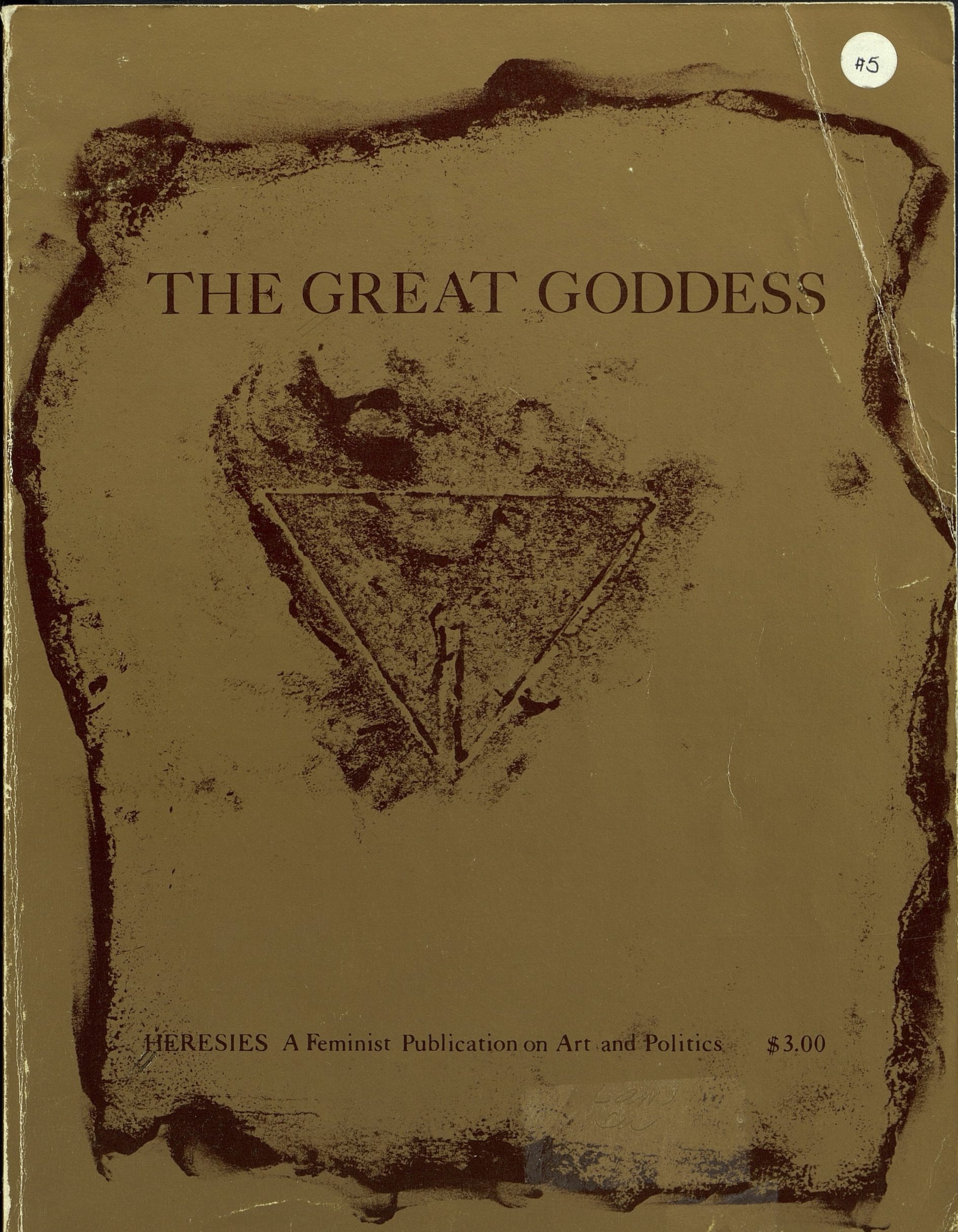
The Great Goddess
Volume 2, Number 1. 1978
-
-
Read the Issue
Explore Issue #5 in PDF format with full-text search or as individual entity-tagged TEI documents.
The Issue 5 Collective
Mary Albanese, Martha Alsup, Tracy Boyd, Janet Culbertson, Rosemary Dudley, Mary Beth Edelson, Gail Feinstein, Deborah Freedman, Gina Foglia, Donna Henes, Anne Healy, Buffie Johnson, Diane Levin, Grace Shinell, Merlin Stone, Carolee Thea, Susan Turner, Mierle Laderman Ukeles.
Collective Statement:
In putting together this issue on The Great Goddess/Women’s Spirituality, we wanted to offer a holistic concept of the Goddess and to move beyond an inside/outside duality. We also recognized a need to counter the distrust that most women harbor towards religion and any aspect of spirituality because of the oppression that we have all experienced from patriarchal religions.
During the year that we have been working together, our collective process has passed through several phases. In the beginning we had meetings attended by 30 or more women, which required us to separate into committees. The committee division continued to evolve and resulted in three main editorial groupings: Personal/Ritual/Poetry/Fiction; Archaeological/Historical/Political/Theological; and Visual, which selected material for submission to the full collective. Initially we attempted to create a review system so that everyone could have an opportunity to see all submissions. However, some material could not be easily duplicated and few people made the independent effort to look through the material from other committees. Because we were committed to the concept of total collective energy and process, we held a marathon weekend on a Long Island farm where more than 30 women met in a communal atmosphere to review and make recommendations about submissions. Over the next four months the full collective continued to make selections and often reviewed rejected material. Committees were engaged in editing, shortening long articles to fit within space limitations, retyping, phoning and corresponding with contributors and soliciting material. During this intense period, members often had to attend three and four meetings a week. Our numbers dwindled to about 20.
In the next phase we reviewed the editing of accepted pieces and began layout and design of the magazine. Because we were far behind schedule, a number of women who had worked hard were no longer able to give priority to their involvement in the collective. Also only a few women were willing to become heavily involved in production work. Some women pitched in; some women hung in; some women checked in. But, again, throughout this phase all decisions were open to the full collective at specially arranged meetings. We felt that we had to make an effort to respect the contributions of all without assessing participation. We did not want to regard decision-making as a power.
There was often muted and, occasionally, dramatic conflict. In a smaller group, confrontation and its resolution would have had to be more directly resolved, but the size of our group permitted distancing and an evasion of differences that sometimes left individuals antagonistically engaged or estranged. A basic source of contention was our disparate definitions of the Goddess. Nor did we find an honest way to handle the implicit and often explicit coercion involved in submitting our own work. Egotism about individual creations and their significance/prominence flared. Our own inefficiency and ineptitude wearied us. The work was not equally shared, although the decision process was. Decision-making in so large a group was extremely slow. Our original committee division aroused factionalism. Members of committees felt that their subject matter was not being fully respected by members of other committees and defensive attitudes developed. However, our slowness may have achieved a greater fairness and even our factionalism may have clarified viewpoints that otherwise would have been blunted by the consensus-voting process, and right to this moment, we have continued to challenge ourselves by seeking collective consensus on an infinitude of decisions. We feel that we tested the collective process and that that process not only produces the most representative work but also withstands the greatest stresses. Although our sharing must include the knowledge of how we were often divided against ourselves, there were also many good times when we shared a heightened regard for each other, when we felt that we were touched by the Goddess.