
Art History as a discipline has yet to critique its use of language as a powerful tool for reinforcing unspoken stereotypes and norms. “Art Hysterical Notions of Progress” written by Valerie Jaudon and Joyce Kozloff exposes how key art historical figures have produced an exclusionary and oppressive fine art community. The article uses quotes from textbooks, newspapers, and media outlets that explore morality, purity, racism, and sexism through the eyes of the elite in the art industry. The hierarchies of art examined through this text are only the foundation of a much larger oppressive machine that works against artists who are not members of the “in group”.
fadhjkhfdajkhfjkdahljfh
When looking online for “famous art” the first 5+ pieces that appear are paintings produced by this “in group”- white, educated, heterosexual males.
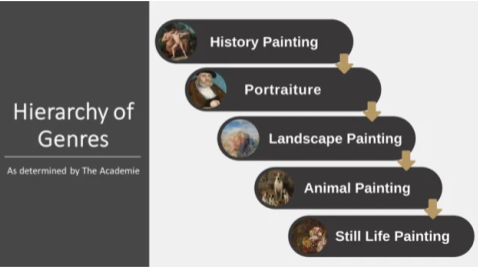
Hierarchies of art styles can be viewed across generations and cultures since the beginning of time, often supporting and funding similar types of artists and art pieces. Whether it is the educational status of the artist, the material they use, or the subject matter they depict, artists work within a framework of “good vs bad art” that is molded and perpetuated by language. But who decides the inherent value of art? Societies' understanding of art and its worth are rooted in a few main sources: art historians, art critics, and artists themselves. The pinnacle example of artistic echelons is 18th-century French Art, specifically the Académie Royale de Peinture et de Sculpture (Royal Academy of Painting and Sculpture). The Académie was established in 1648 under King Louis XIV to develop and cultivate French Artists as well as the identity and representation of the monarchy. The fine arts school provided instruction from the most well-regarded artists of the time, the opportunity to contribute to distinguished exhibitions, and access to prestigious commissions/connections. The school required an intensive application process that only accepted Western, white, educated, men. Once accepted its members faced a system founded on hierarchies. Not only were its members rated in terms of importance, but the types of artwork they created were ranked. In the strict hierarchy promoted by the Academy, "history painting," which included religious, mythological, and historical subjects, was the most highly esteemed. Next came portraiture, then landscape and still life. This is not to say that other types of art were not being created during this time, however, if it was not promoted through the language or culture of the French monarchy. This specific hierarchy was plainly viewed, compared to other modes of creative oppression. Using 18th-century French Art as an example of hierarchies advanced by the fine arts, we can zoom out and look at the hierarchies between other classifications: sculpture vs painting, western vs non-western, and men vs women artists.