
Heresies: A Brief History
Heresies is a feminist publication on art and politics, first conceived in 1975 in New York City by a small collective of women, and inspired by the developments of the 1970s feminist movement. The organizing body—the “Mother Collective”—included artists, critics, and activists who came together to produce a journal that would publish exclusively feminist work. Their goal was to present diverse perspectives, stimulate dialogue, and, most importantly, create a platform for yet-unheard female voices.
During their active years, spanning from 1977 to 1993, Heresies produced 27 issues that included essays, artwork, poems, and other visual media. Pieces in a given issue fall under one central topic or theme, chosen by the editorial team for their respective issue. Themes range from women and violence to music, community, lesbianism, film, sex, racism, and satire. Every issue also contains an original design concept specific to the editorial team responsible for its production.
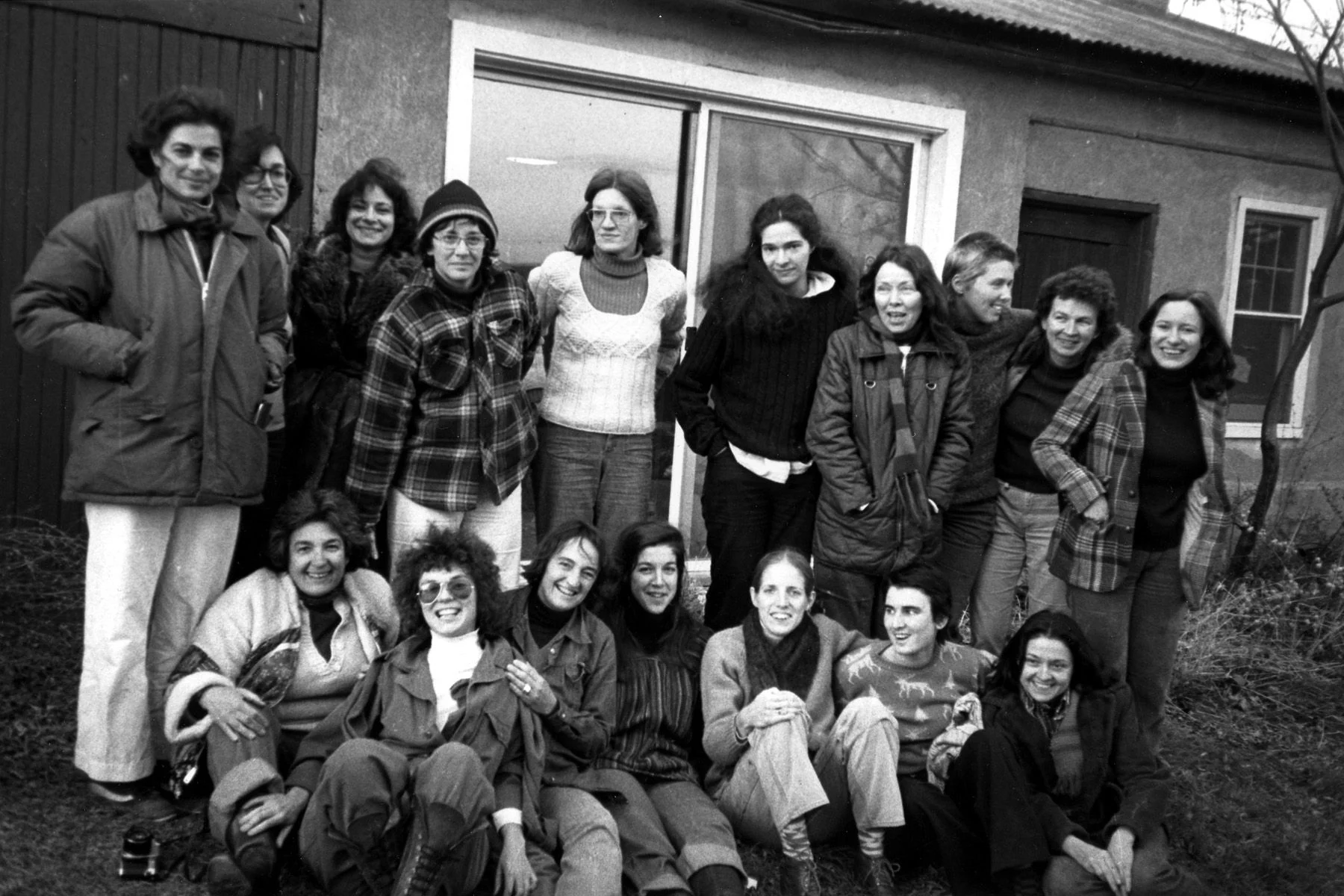
A photograph taken of members of the Heresies Collective at Joan Snyder's farm (n.d.). Members pictured here include, standing: Mary Miss, Joyce Kozloff, Arlene Ladden, Joan Snyder, Patsy Beckert, Elizabeth Hess, May Stevens, Harmony Hammond, Sally Webster, Susana Torre and, seated: Miriam Schapiro, Mary Beth Edelson, Lucy Lippard, Joan Braderman, Elizabeth Weatherford, Mary Pottenger, and Michelle Stuart (photograph by Edelson). Members not pictured are Elke Solomon, Pat Steir, and Nina Yankowitz.
The Heresies Collective evolved and changed over the 25 years of publication, with members stepping forward or moving on depending on their interests.
The "Mother Collective" included Patsy Beckert, Joan Braderman, Mary Beth Edelson, Harmony Hammond, Elizabeth Hess, Joyce Kozloff, Arlene Ladden, Lucy Lippard, Mary Miss, Marty Pottenger, Miriam Schapiro, Joan Snyder, Elke Solomon, Pat Steir, May Stevens, Michelle Stuart, Susana Torre, Elizabeth Weatherford, Sally Webster, and Nina Yankowitz. The group published this mission statement in the inaugural issue:
"HERESIES is an idea-oriented journal devoted to the examination of art and politics from a feminist perspective. We believe that what is commonly called art can have a political impact, and that in the making of art and of all cultural artifacts our identities as women play a distinct role. We hope that HERESIES will stimulate dialogue around radical political and esthetic theory, encourage the writing of the history of femina sapiens, and generate new creative energies among women. It will be a place where diversity can be articulated. We are committed to the broadening of the definition and function of art.
HERESIES is structured as a collective of feminists, some of whom are also socialists, Marxists, lesbian feminists or anarchists; our fields include painting, sculpture, writing, anthropology, literature, performance, art history, architecture and filmmaking. While the themes of the individual issues will be determined by the collective, each issue will have a different editorial staff made up of contributors as well as members of the collective. Each issue will take a different visual form, chosen by the group responsible. HERESIES will try to be accountable to and in touch with the international feminist community. An open evaluation meeting will be held after the appearance of each issue. Themes will be announced well in advance in order to collect material from many sources. (See inside of back cover for list of projected issues.) Possibly satellite pamphlets and broadsides will be produced continuing the discussion of each central theme.
As women, we are aware that historically the connections between our lives, our arts and our ideas have been suppressed. Once these connections are clarified they can function as a means to dissolve the alienation between artist and audience, and to understand the relationship between art and politics, work and workers. As a step toward a demystification of art, we reject the standard relationship of advertiser to product. We will not advertise a new set of genius-products just because they are made by women. We are not committed to any particular style or esthetic, nor to the competitive mentality that pervades the art world. Our view of feminism is one of process and change, and we feel that in the process of this dialogue we can foster a change in the meaning of art." (Heresies #1, January 1977.)